Anthropic releases Claude Opus 5
- Maxime Hiez
- Anthropic
- 24 Jul, 2026
Introduction
Anthropic made Claude Opus 5 generally available on July 24, 2026, as the successor to Claude Opus 4.8. Pricing remains unchanged at 5$ / 1M input tokens and 25$ / 1M output tokens, but the model aims to rival Claude Fable 5, Anthropic’s frontier model, at half the price. It is the first time a major Opus line upgrade comes with no price increase.
Check the Claude Opus 4.8 article HERE.
The Claude family in 2026
The Opus 5 announcement is part of a full lineup refresh, with the shift away from sub-version numbering in favour of proper names for the flagship models. The current hierarchy has five tiers :
- Claude Mythos 5 : Invitation-only model dedicated to defensive cybersecurity under the Glasswing project. Priced at 10$ / 50$ per 1M tokens.
- Claude Fable 5 : Most powerful model in general access, identifier claude-fable-5. Priced at 10$ / 50$ per 1M tokens.
- Claude Opus 5 : Designed for complex agentic tasks and enterprise work, identifier claude-opus-5. Priced at 5$ / 25$ per 1M tokens.
- Claude Sonnet 5 : Best balance of speed and intelligence, identifier claude-sonnet-5. Priced at 3$ / 15$ per 1M tokens (promotional rate of 2$ / 10$ until August 31, 2026).
- Claude Haiku 4.5 : Fastest in the lineup, identifier claude-haiku-4-5-20251001. Priced at 1$ / 5$ per 1M tokens.
What’s new with Claude Opus 5
The most structural change is the introduction of native Adaptive thinking. Unlike Claude Fable 5, which reasons intensively at all times, Opus 5 scales its reasoning effort to the complexity of the task. The effort parameter defaults to high in the API and in Claude Code ; teams can adjust it explicitly to control the speed versus depth trade-off.
Two additional improvements are highlighted by Anthropic :
- Enhanced self-verification : The model iterates on its own outputs more systematically, reducing silent errors in multi-step agentic workflows.
- Visual outputs : Opus 5 can generate visual content as part of its responses, a capability absent from Opus 4.8.
The training data cutoff is set to May 2026, which is more recent than Claude Fable 5 and Claude Sonnet 5 (January 2026 for both).
Benchmarks
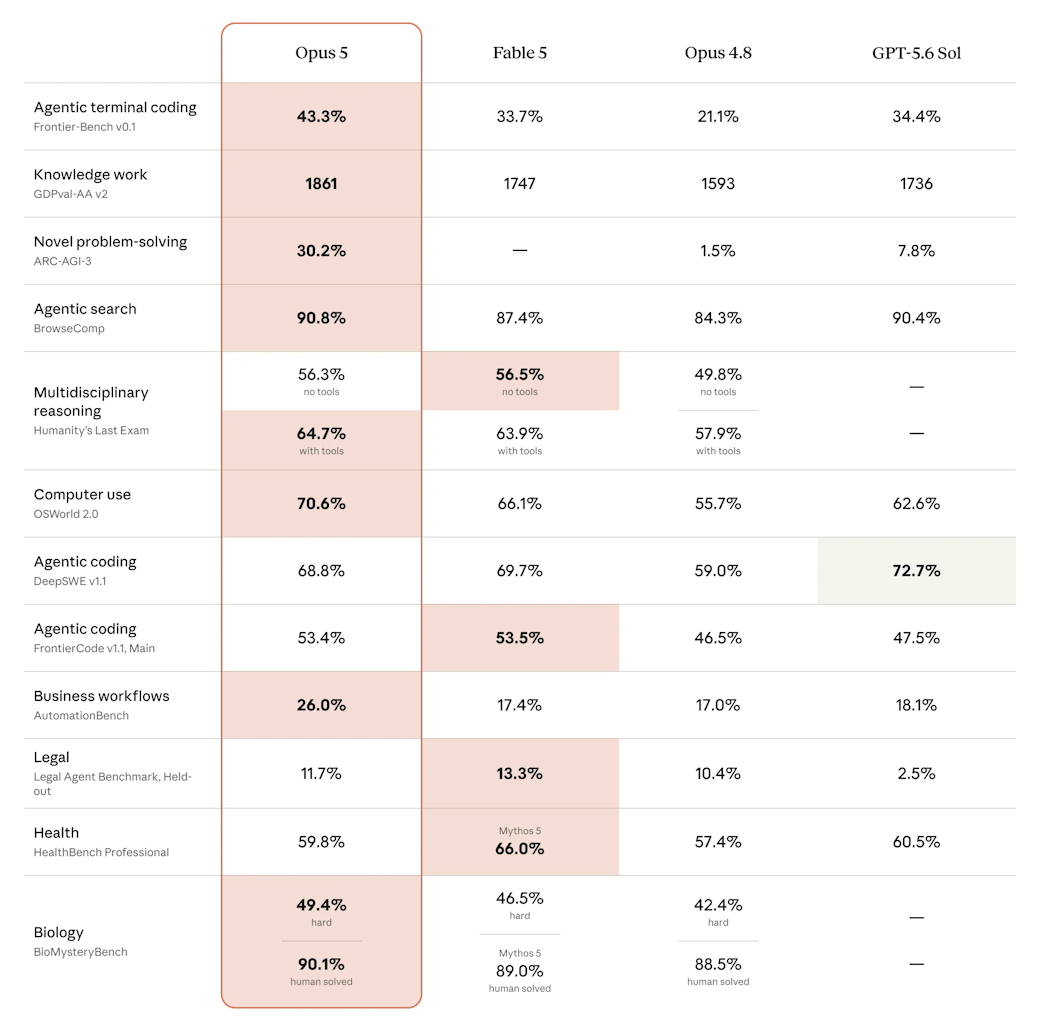
Anthropic cites several proprietary or partner benchmarks to position Opus 5. No results on classic academic evaluations (MMLU, GPQA, SWE-bench, HumanEval) are published in the launch announcement :
- CursorBench 3.2 : Results within 0.5% of Fable 5 at half the cost.
- ARC-AGI 3 : Score three times higher than the next-best competing model.
- Zapier AutomationBench : Pass rate approximately 1.5 times higher than the next model.
- OSWorld 2.0 : Surpasses Fable 5 on computer use tasks at approximately one-third of the cost.
On scientific domains, two specific gains are indicated compared to Opus 4.8 :
| Delta vs Opus 4.8 | |
|---|---|
| Organic chemistry | +10.2 pts |
| Protein prediction | +7.7 pts |
Three launch partners have shared their experience :
- Devin : Qualifies Claude Opus 5 “as approaching Fable-level performance at half the cost”.
- Cursor : Describes Claude Opus 5 as offering “near Fable 5 intelligence at Opus speed and cost”.
- Zapier : Reports that Opus 5 “hit 100% on full automation workflows”, where previous models failed.
Pricing and availability
The base price of Opus 5 is identical to Opus 4.8 : 5$ / 1M input tokens and 25$ / 1M output tokens. A Fast mode is available as a research preview at 10$ / 50$ per 1M tokens, for a speed gain of approximately 2.5 times. This mode is only accessible via the direct Anthropic API and is not yet available on third-party platforms. The Batch API offers a 50% discount, at 2.50$ / 12.50$ per 1M tokens. Prompt caching is available at 0.50$ / 1M tokens per cache hit.
The model is accessible under the identifier claude-opus-5 on the direct Anthropic API, Google Cloud Vertex AI, Claude.ai, Claude Code, and Claude Cowork. It is also available on AWS Bedrock and Microsoft Foundry.
Conclusion
Claude Opus 5 is the most straightforward upgrade available to teams running Opus 4.8 on the Anthropic API : identical pricing, measurable improvements on agentic and scientific tasks, and adaptive reasoning without permanent overhead. Teams whose workflows do not require the absolute power of Fable 5 now have a rational entry point into the high-end lineup. For use cases demanding the best absolute performance, Fable 5 remains the choice, at the cost of accepting double the price.
Sources
Did you enjoy this post ? If you have any questions, comments or suggestions, please feel free to send me a message from the contact form.
Don’t forget to follow us and share this post.