Mistral OCR 3, a precise, structured and affordable OCR
- Maxime Hiez
- Mistral AI
- 15 Jan, 2026
Introduction
In December 2025, Mistral AI announced the launch of Mistral OCR version 3, an Optical Character Recognition (OCR) API that sets a new standard for document understanding. This advanced technology enables the processing and transcription of complex documents with unparalleled accuracy and speed, delivering unprecedented document comprehension capabilities.
What’s new with OCR 3
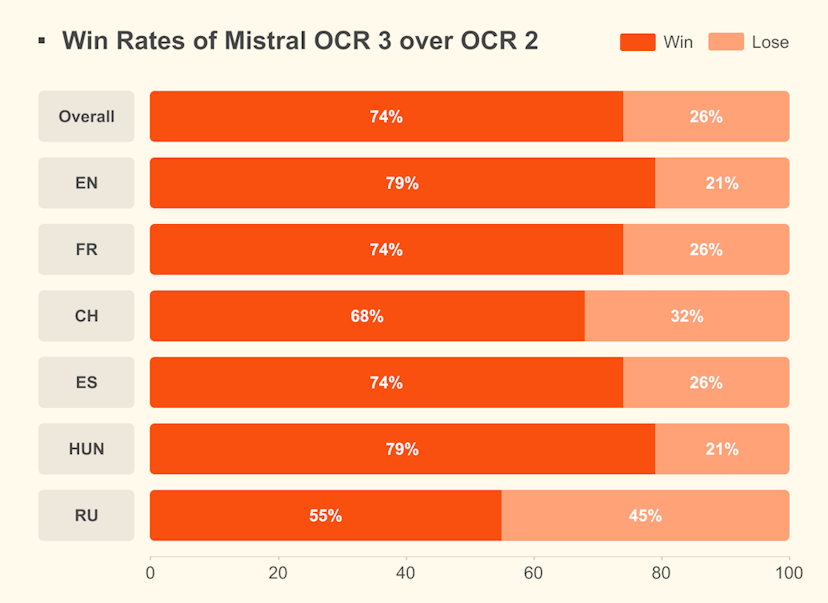
- Significantly improved form accuracy : Handwriting, degraded scans, and complex tables, with a 74% improvement compared to OCR 2 (internal evaluations on business cases, etc.).
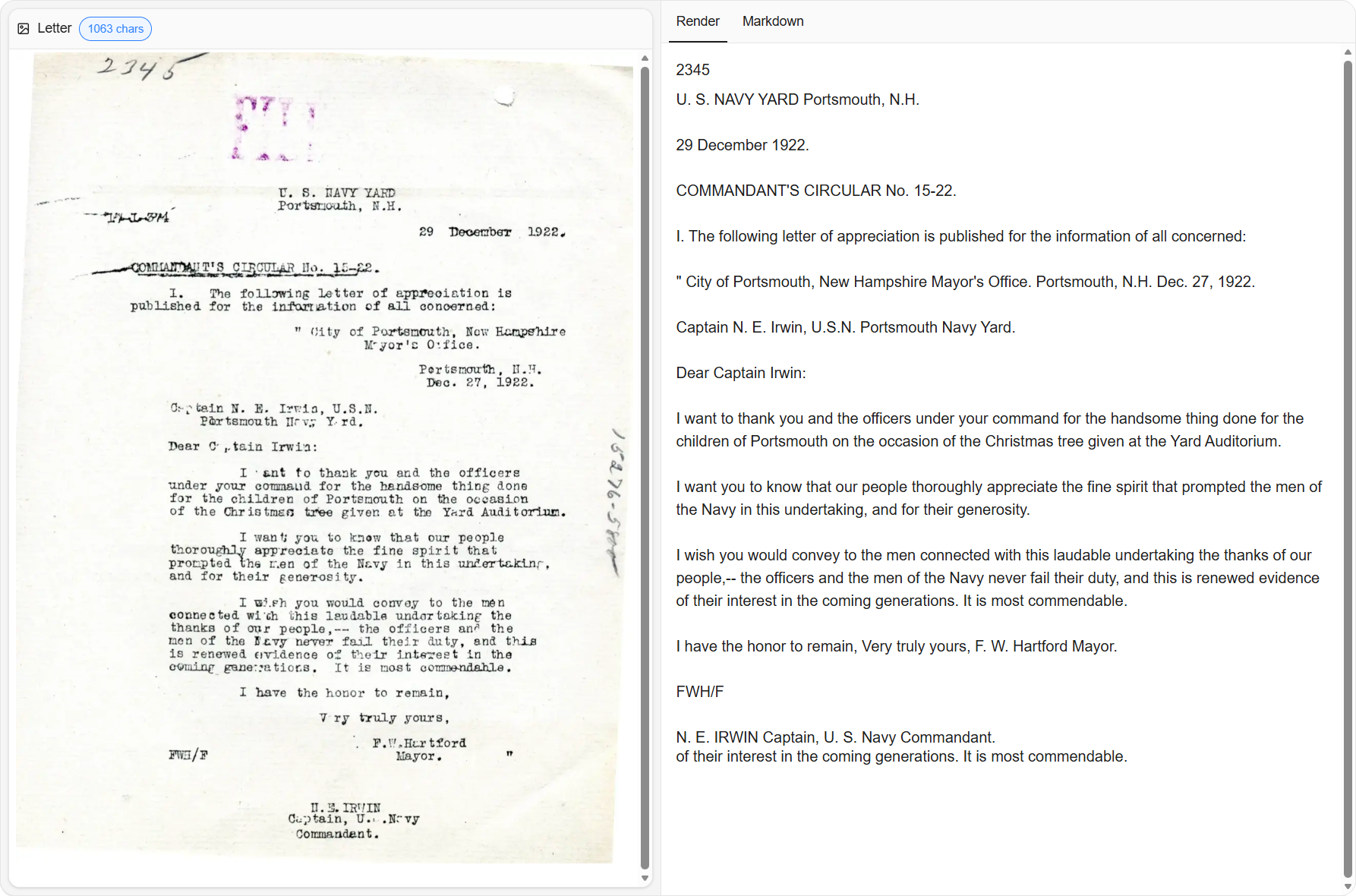
- Structured output : OCR3 produces Markdown that preserves formatting and reconstructs tables in HTML (rowspan/colspan).
- Designed for automation : The API response includes JSON with a list of pages (markdown per page, images, detected links, optional headers/footers), and structured annotations.
Developer and Studio Experience
- Template : mistral-ocr-2512 (integration via public API).
- Document AI Playground in Mistral AI Studio : Import a PDF or image and retrieve clean text or structured JSON without coding.
- Smart placeholders : Markdown references images / tables via placeholders (![img-0.jpeg], [tbl-3.html]) resolved from the image arrays / tables in the JSON, this simplifies faithful document reconstruction.
Pricing and availability
- Standard : 2$ / 1 000 pages
- Batch API : -50% or 1$ / 1 000 pages
- Structured Annotations : 3$ / 1 000 pages
At these price points, OCR 3 outperforms many enterprise document extraction solutions while delivering excellent quality for complex cases (forms + handwriting + tables).
Use cases
- Invoices, purchase orders, KYC : Ready-to-use field extraction + limited human validation thanks to HTML/JSON structures and layout preservation.
- Scanned archives and files : Increased resilience to degraded scans; better management of handwritten notes and annotations to create searchable archives or train AI agents.
- Complex tables (banking, healthcare, public) : HTML + Markdown reconstruction facilitates ingestion into analytical pipelines.
Why now ?
Mistral positions OCR as the first building block of an enterprise AI strategy. As long as critical data on paper/PDF is not digitized and structured, AI use cases remain confined to the proof-of-concept stage. OCR 3 aims to unlock these data resources and accelerate the transition from pilot to production (process automation, agents, etc.).
How to get started ?
- Test in the Playground (PDF/Image -> text/JSON) to validate the quality of your documents.
- Prototype the mistral-ocr-2512 API ; enable the Batch API for large volumes (cost ÷2).
- Store the generated JSON/HTML files, connect a post-processing tool (rules, mapping, LLM, RPA), and monitor.
Conclusion
Mistral OCR3 delivers next-generation OCR : accurate on complex cases, structure-aware for automation, and cost-effective at scale. For organizations looking to open their document data to AI (agents, analytics, etc.), it’s an immediate accelerator ; simple to test, quick to deploy, and affordable.
Sources
Did you enjoy this post ? If you have any questions, comments or suggestions, please feel free to send me a message from the contact form.
Don’t forget to follow us and share this post.